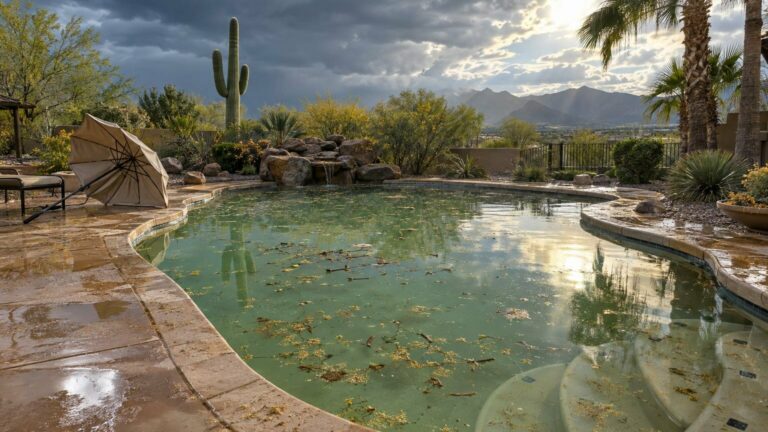
A salt pool is supposed to make its own chlorine. So when the chlorine reads zero and the water starts turning cloudy or green, it’s confusing. The salt level looks fine. The system is on. What’s going on?
In the Phoenix area, the answer is usually the salt cell. Our hard water is tough on it. This post covers how a salt cell works, why Valley water causes problems, how to tell if your cell is the issue, and what to do about it.
If you’re still deciding between a salt system and regular chlorine, start with our older post on saltwater vs. chlorine pools. This one is for people who already have a salt pool.
How a Salt Cell Makes Chlorine
A salt pool isn’t chlorine-free. It just makes its chlorine on site instead of you pouring it in.
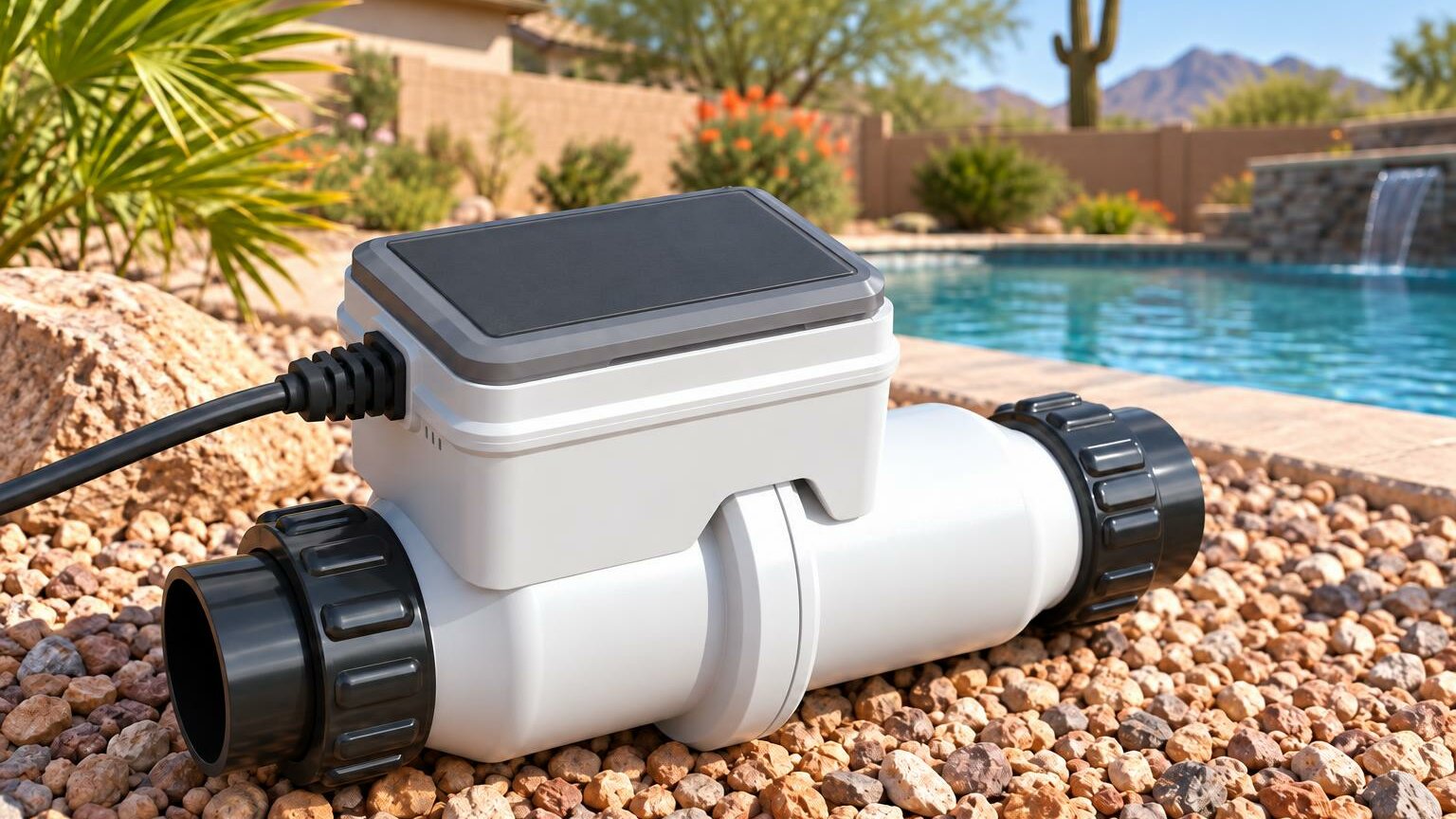
Here’s the short version. You add salt to the pool water, about as much as it takes to make the water taste a little salty. The water flows through the salt cell, which is a tube with metal plates inside. The system sends a low electric current across those plates. That current turns some of the salt into chlorine, which then flows back into the pool and cleans the water.
A few things matter here:
- The cell only works when water is moving through it. If the pump isn’t running, no chlorine is being made.
- The plates have to be clean. The current has to reach the water to do its job.
- The salt level has to be in range. Too little and the cell can’t make enough. Too much can cause its own problems.
Why Phoenix Water Is Hard on Salt Cells
Phoenix tap water is some of the hardest in the country. That means it carries a lot of calcium. Every time your pool tops off, it adds more.
The salt cell is where that calcium causes trouble. While the cell is making chlorine, the water right at the plates gets a higher pH than the rest of the pool. High pH makes calcium come out of the water and stick to surfaces. So the plates slowly get coated with a hard white crust. That’s scale.
Scale acts like a blanket over the plates. The more of it there is, the less current reaches the water, and the less chlorine the cell makes. Eventually it makes almost none.
Heat makes it worse. Calcium scales faster in warm water, and our pool water runs in the 90s for months. So a salt cell in Phoenix can scale up much faster than the same cell in a cooler, softer-water place.
Summer Heat: The Salt Pool Problem Most People Don’t Know About
Here’s something we deal with every summer that most salt pool owners have never heard about. In Phoenix, cold water isn’t the problem. Hot water is.
When your pool water climbs into the 90s, the salt cell struggles to produce enough chlorine. At the same time, the pool needs more chlorine than ever. The heat and strong sun burn it off fast, and more people are swimming. The cell can be clean, the salt level can be right, and the system can be running just fine, and it still can’t keep up.
That’s why we supplement salt pools with liquid chlorine or chlorine tabs during the hot summer months. It’s normal, and it doesn’t mean anything is broken. The salt system still does most of the work. The extra chlorine just covers the gap on the hottest days so algae doesn’t get a head start.
If you take care of your own salt pool, watch your chlorine closely from about June through September. If it keeps reading low even with the output turned up, don’t assume the cell is dead. Add some liquid chlorine and test again the next day. Once the water cools off in the fall, the cell usually catches back up on its own.
Signs Your Salt Cell Is the Problem
Watch for these:
- Low chlorine, even though the salt level reads fine
- Cloudy water or a green tint that keeps coming back
- The output setting is turned way up and chlorine is still low
- A “check cell” or “inspect cell” light on the control panel
- White crust or flakes on the plates when you look inside the cell
If you see white buildup between the plates, you’ve found your answer.
Other Reasons a Salt Pool Stops Making Chlorine
Scale is the most common cause, but it’s not the only one. Before you blame the cell, check these:
Salt level is off. Most cells want roughly 3,000 ppm of salt, give or take. Check your model’s manual for the exact range. Rain, splash-out, and draining can lower it. Too high can also cause problems.
Pump run time is too short. Remember, the cell only works while water flows. In summer, a pool needs more chlorine, so the pump needs to run longer. A timer set for winter hours won’t cut it in July.
Stabilizer is low. Without stabilizer (cyanuric acid), the sun burns off chlorine almost as fast as the cell makes it. This is a big one in Arizona.
The water is too warm. This one surprises a lot of people. When pool water gets into the 90s, as it does every Arizona summer, a salt cell often can’t make enough chlorine to keep up. That’s why many salt pools need some liquid chlorine added in the summer.
The cell is worn out. Salt cells don’t last forever. The coating on the plates wears down over time. Many last somewhere around three to seven years, depending on the model, how hard it works, and how it’s cared for. Hard water and heavy use shorten that.
A sensor or flow switch has failed. If the system doesn’t think water is flowing, it won’t make chlorine. That calls for a repair tech.
How to Check and Clean a Salt Cell
If you’re comfortable doing it yourself, here’s the general process. Always follow your cell maker’s instructions, since they vary.
- Turn off the power to the pump and the salt system at the breaker.
- Close the valves if your system has them, then remove the cell.
- Look inside. Hold it up to the light. White crust between the plates means it needs cleaning.
- Rinse off loose debris with a garden hose.
- Soak the cell in a mild acid solution made for cleaning salt cells, or the mix your manual calls for. Always add acid to water, never water to acid. Wear gloves and eye protection.
- Let it fizz. The bubbling is the scale dissolving. When it stops, the cell is usually clean.
- Rinse it well and put it back. Check for leaks when you turn the pump on.
Don’t scrape the plates with a screwdriver or anything metal. That can damage the coating and ruin the cell.
Muriatic acid is dangerous stuff. If you’d rather not handle it, that’s a good reason to have a pro do it.
How Often to Check It in Phoenix
The manual might say to check the cell every few months. In Phoenix, that’s a minimum. Pools with high calcium or heavy use may need it more often, especially in summer. We look at the salt cell on every visit for our salt pool customers, so scale gets caught before chlorine drops.
How to Slow Down Scale
You can’t stop hard water, but you can slow the buildup:
- Keep pH in range. We aim for 7.4 to 7.6. Salt pools tend to push pH up, so it needs regular attention. Our chemical balancing page lists all the ranges we use.
- Keep calcium hardness in range. We aim for 200 to 400 ppm. Over the years it creeps higher as water evaporates and minerals stay behind. At some point a drain and refill is the only real fix.
- Watch total alkalinity. High alkalinity makes pH climb faster.
- Use the self-cleaning feature if your cell has one. Many cells flip the current direction now and then to shed scale. It helps, but in Phoenix it usually isn’t enough on its own.
Repair or Replace?
If cleaning the cell brings chlorine back, you’re set. If the plates look worn, or the cell still won’t make enough chlorine after a good cleaning, it may be at the end of its life. At that point you’re looking at a new cell. Sometimes the control board or a sensor is the real problem, so it’s worth having someone test the system before you buy parts.
Our repair team tests salt systems, replaces cells and boards, and installs new salt systems too. We’ll tell you what’s wrong and what it costs before we do any work.
What a Salt Pool Still Needs Every Week
A salt system takes care of making chlorine. It doesn’t take care of the rest. Every week, a salt pool still needs:
- Skimming, brushing, and vacuuming. Salt doesn’t pick up leaves.
- Emptying the baskets. A clogged basket slows the water, and slow water means less chlorine made.
- A water test. Check chlorine, pH, and salt. Check alkalinity, calcium, and stabilizer at least once a month.
- Acid as needed. To keep that pH from creeping up.
- A look at the filter pressure. A dirty filter means less water through the cell.
That’s why “set it and forget it” doesn’t work, even with a salt pool.
Salt Pools Around the Valley
Salt systems are especially common in newer homes. In places like Surprise, Goodyear, and North Phoenix, a lot of builder pools come with one already installed. Many new owners assume that means the pool takes care of itself. It doesn’t. The cell still needs checking, and the water still needs balancing.
Common Questions
Can I just add regular chlorine to a salt pool?
Yes. If the cell is down, adding liquid chlorine keeps the pool safe until it’s fixed. It won’t hurt the system. We do it on a lot of salt pools every summer anyway, since the cell has a hard time keeping up when the water is hot.
Why is my salt pool’s pH always high?
Making chlorine from salt pushes pH up as a side effect. That’s normal for salt pools. It just means you’ll add acid more often than you would with a regular chlorine pool.
My salt level reads low but I just added salt. Why?
The salt reading usually comes from the cell. A scaled or failing cell can give a false low reading. Clean the cell and check the salt with a test strip or kit before adding more. Too much salt is harder to fix than too little.
Does salt damage my pool deck or equipment?
Salt water can wear on some natural stone, metal railings, and older heaters over time. Rinsing splash-out off the deck helps. Keeping the salt level in the right range, not too high, helps most of all.
Should I switch my regular chlorine pool to salt?
It depends on what you want. A salt system means less chlorine to buy and handle, and softer-feeling water. It also means a cell to look after and replace down the road. Our older post on saltwater vs. chlorine walks through the trade-offs. If you decide to switch, our repair team installs salt systems.
Do you service salt pools?
Yes. On every visit we check the salt level, look at the cell, and balance the water. It’s part of our pool maintenance service.
The Bottom Line
In Phoenix, a salt pool that stops making chlorine is usually a scaled cell. Check it, clean it, and keep your pH and calcium in range to slow the next round. If it still won’t make chlorine, have the system tested before you replace parts.
Need a hand? Call (623) 526-4945 or request an estimate online. We take care of salt pools all over the Valley.