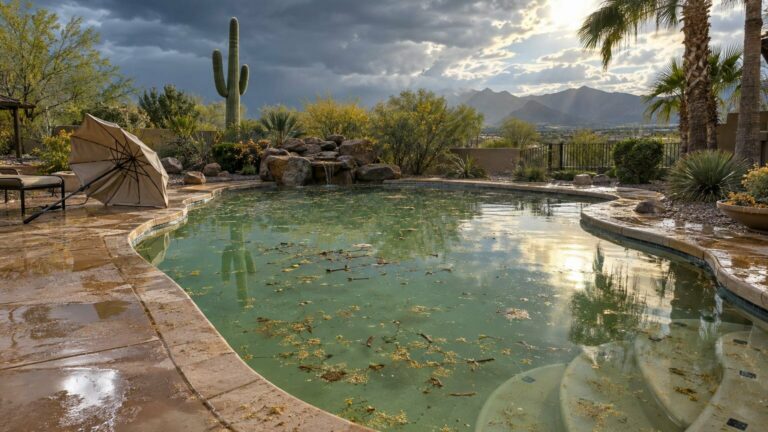
You filled the pool on Saturday. By Wednesday it’s down again, and the skimmer is starting to gulp air. Is something leaking, or is that just Arizona?
Most of the time, it’s Arizona. Our heat, dry air, and wind pull a lot of water out of a pool. But leaks happen too, and a slow one can go on for months before anyone catches it. The bucket test is a free, simple way to tell the two apart. This post explains how much water loss is normal here, how to do the bucket test the right way, the mistakes that throw it off, and what to do with the answer.
How Much Water Does a Phoenix Pool Lose?
More than people expect. Evaporation depends on the air temperature, the water temperature, the humidity, the wind, and the sun. In Phoenix, almost all of those push the same way.
Here’s a rough idea of what a typical backyard pool loses to evaporation alone:
| Time of year | Rough daily loss | What it adds up to |
|---|---|---|
| June to August | About 1/4 inch a day, sometimes more | 1 1/2 inches or more a week |
| Spring and fall | Around half the summer rate | About an inch a week |
| December to February | Much less | A fraction of an inch a week |
These are ballpark numbers, not rules. A pool in full sun on a windy lot loses more. A pool with shade and a block wall around it loses less. A waterfall, a spa spillover, or a sheer descent can add a lot, since moving water in the air evaporates fast.
The point is this: losing an inch or two a week in summer doesn’t mean you have a leak. To know for sure, you need to compare your pool to water sitting in the same spot, in the same weather. That’s what the bucket test does.
What You’ll Need
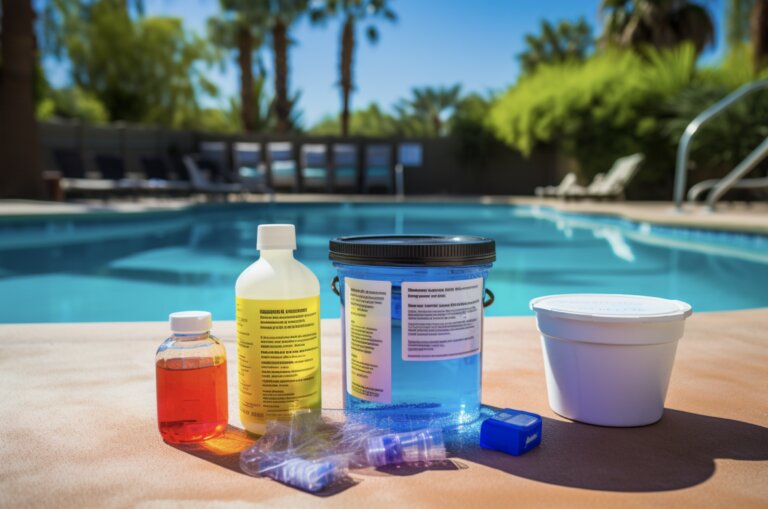
- A plastic bucket, 5 gallons is perfect
- A strip of tape or a waterproof marker
- A few bricks or a heavy rock (optional, for windy days)
- Two or three days where you won’t add water to the pool
That’s it. No dye, no tools, no cost.
How to Do the Bucket Test
1. Fill the pool to its normal level. Get the water about halfway up the skimmer opening, where it should be. Turn off the auto-fill if you have one. This is important. An auto-fill will quietly top off the pool and ruin the test.
2. Fill the bucket with pool water. Use water from the pool, not the hose. It should be the same temperature as the pool.
3. Set the bucket on a pool step. Put it on the first or second step so most of the bucket sits in the pool water. The water inside the bucket should be at about the same height as the pool water outside it. If the bucket floats or tips, put a brick or two inside it before you fill it.
4. Mark both water lines. Put a piece of tape or a marker line at the water level inside the bucket. Then put another mark on the outside of the bucket at the pool’s water level.
5. Run the pool like normal. Let the pump run on its usual schedule. Don’t swim, don’t add water, and don’t backwash.
6. Wait 24 to 48 hours, then compare. Measure how far the water dropped inside the bucket. Then measure how far the pool dropped on the outside of the bucket.
How to Read the Results
If both dropped about the same: that’s evaporation. The pool is losing the same water the bucket is. No leak.
If the pool dropped more than the bucket: you likely have a leak. A difference of an eighth of an inch or more over 24 hours is worth looking into.
If the bucket dropped more than the pool: something’s off with the test. Rain may have filled the pool, or the bucket may have tipped or been splashed. Do it again.
Do It Twice: Pump On, Pump Off
Once you know you’re losing water, run the test a second time with one change. If the first test had the pump running, do the second one with the pump off the whole time. Or the other way around.
This tells you a lot about where the leak is:
- Pool loses more with the pump on: the leak is likely on the pressure side. That’s the plumbing that carries water from the pump back to the pool, plus the filter, the heater, and the return lines.
- Pool loses more with the pump off: the leak is likely on the suction side or in the pool itself. Think skimmer, main drain, suction lines, lights, or a crack in the shell.
- Same either way: the leak is probably in the pool shell, a fitting in the wall, or the light niche, not in the plumbing.
In summer, don’t leave the pump off longer than you need to. Water that sits still in our heat can start growing algae in a day or two.
Mistakes That Throw Off the Test
We see these a lot when someone tells us their bucket test “didn’t work”:
- Leaving the auto-fill on. The most common one. The pool looks fine because the auto-fill keeps adding water.
- Putting the bucket on the deck. A bucket in the sun on hot concrete heats up and loses more water than the pool. It has to sit in the pool.
- Running water features during the test. If the waterfall ran for one part and not the other, the numbers won’t line up.
- Testing during a storm. Rain and wind make the results useless. Pick a calm stretch of days.
- Swimming during the test. Splash-out counts as water loss.
- Using hose water in the bucket. Cold hose water evaporates slower than warm pool water at first.
Where Leaks Usually Hide
If the test says you have a leak, these are the most common spots, roughly from easiest to hardest to find:
- The equipment pad. Look for drips, wet spots, or white crust around the pump, filter, valves, and heater. A worn pump seal or a cracked fitting is an easy fix.
- The skimmer. The joint where the plastic skimmer meets the concrete shell often cracks.
- The light niche. The conduit that runs the light cord can let water out.
- Return jets and steps. Fittings in the wall can loosen or crack.
- The pool finish. Look for cracks in the plaster or pebble, and tiles that have popped off.
- Underground pipes. These are the hardest to find and usually need a pro.
Try the Food Coloring Trick
If you think you’ve found the spot, you can test it with a little food coloring or leak-detection dye. Turn off the pump so the water is still. Get close to the crack or fitting and squeeze a few drops into the water right next to it. If there’s a leak, the color will get pulled toward it and disappear into the crack. If it just floats, that spot is probably fine.
This works best for cracks at the skimmer, around the light, and at the steps. You may need a mask and snorkel for spots below the waterline.
Water You’re Using Without Noticing
Before you decide you have a leak, think about where else water might be going:
- Backwashing. A sand or DE filter can send hundreds of gallons down the drain each time you backwash.
- Splash-out. Kids, dogs, and cannonballs move a lot of water onto the deck.
- Water features. A waterfall in summer can double your evaporation.
- The spa. If the spa spills over into the pool, it’s losing water from more surface area.
If any of these were going on, the bucket test still works. Just keep them steady during the test.
Why It’s Worth Finding a Leak Fast
A small leak wastes thousands of gallons over a summer. That shows up on your water bill. It also shows up in your pool chemistry. Every gallon of new tap water brings in more calcium, so a leaking pool builds up scale faster. You’ll spend more time and money keeping the water balanced.
Worse, water leaking under a deck or the pool itself can wash out the soil underneath. Over time, that can lead to cracks and settling that cost much more to fix than the leak itself.
Common Questions
How much water loss is too much?
In summer, a quarter inch a day is common in Phoenix. If you’re losing more than a half inch a day with no waterfall or spa running, it’s worth doing the bucket test.
My pool only loses water when the pump runs. What does that mean?
It points to a leak on the pressure side, often at the equipment pad or in a return line. Check the pad for wet spots first.
Can a pool leak through the plaster?
Plaster isn’t fully waterproof, but a healthy pool loses very little through it. Real leaks come from cracks, fittings, and pipes.
Should I keep filling the pool while I wait for a repair?
Yes. Don’t let the water drop below the skimmer, or the pump can suck air and burn up. Just keep track of how much you add.
Think You Have a Leak?
If the bucket test says you’re losing water, we can find it and fix it. See our pool leak detection page for how we track leaks down, and our pool plumbing repair page for what happens next. Or just call (623) 526-4945.