You tested the water. Chlorine looks fine. pH looks fine. And the pool is still cloudy. This is one of the most annoying pool problems, and it’s one of the most common calls we get. The good news is that cloudy water almost always comes down to a short list of causes. Once you find the right one, the fix is usually simple.
We’ll walk through them in the order our techs check them. Start at the top and work down.
First, How Cloudy Is It?
It helps to know what you’re looking at.
A light haze. You can see the main drain, but the water looks dull, not sparkling. This is usually a filter or circulation issue, or the very start of algae.
Milky water. You can barely see the floor in the deep end. This often means high pH, high calcium, or very fine particles the filter can’t catch.
Can’t see the bottom at all. Something bigger is going on. It could be algae starting to bloom, dead algae after a shock, or a filter that’s not working at all.
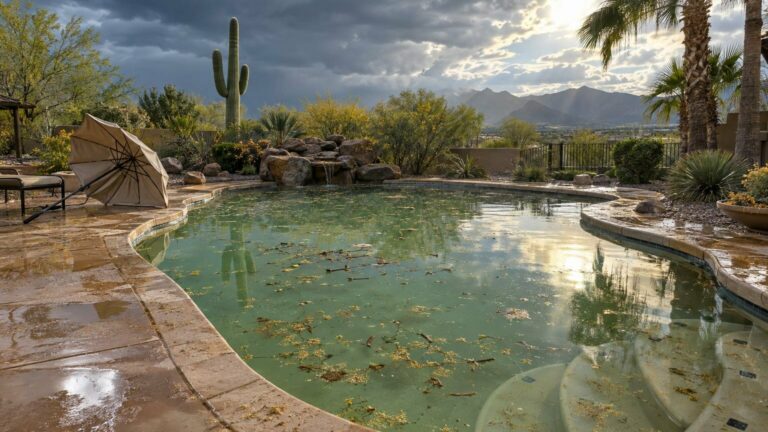
Cloudy with a green tint. That’s algae. Treat it as a green pool, not a cloudy one. Our post on green pools after monsoon storms covers what to do.
Cause 1: The Filter
This is the number one reason we see cloudy water with good chemistry. The filter is what pulls the tiny stuff out of the water. If it isn’t doing its job, the chemicals can be perfect and the water will still look dull.
Check these things:
- Pressure gauge. If it reads about 8 to 10 PSI higher than it does after a clean, the filter is packed and needs cleaning.
- Pressure too low. If the gauge reads lower than normal, water may not be getting to the filter. Look at the pump basket and skimmer basket for clogs.
- Old cartridges. Cartridges wear out. If the fabric is thin, torn, or crusted with scale, they can’t catch fine dirt anymore.
- Torn DE grids. If you have a DE filter and see white powder on the pool floor after backwashing, a grid is likely torn.
- Worn-out sand. Sand gets smooth over years and stops catching small particles. Most sand filters need new sand every several years.
Our filter cleaning and repair page explains how each type works and when it needs service.
Cause 2: Not Enough Run Time
Even a great filter can only clean the water that goes through it. If the pump doesn’t run long enough, part of the water never gets filtered. In summer, most Phoenix pools need 8 to 12 hours of pump time a day. Lots of pools still run on a short winter schedule because nobody changed the timer.
Also look at where the water is going. If a valve is half closed, or the return jets point at the surface instead of down and around, some areas of the pool don’t move much. Dead spots get cloudy first.
Cause 3: pH and Alkalinity Too High
High pH is a big one in the Valley. When pH climbs above about 7.8, two things happen. Chlorine gets weaker, even if the test says there’s plenty. And calcium starts to come out of the water as tiny particles, which turns the water milky.
High alkalinity makes it worse, because it keeps pushing the pH back up after you lower it.
Our targets are pH 7.2 to 7.8 and alkalinity 80 to 120 ppm. If yours is high, add acid a little at a time, let it circulate, and test again. Going too fast can swing it too low.
Cause 4: High Calcium Hardness
Phoenix tap water is hard. Every time you top off, more calcium goes in. Over the years, calcium hardness can climb above 400 ppm, sometimes way above. At that point, the water is close to its limit. A little heat or a small pH bump and calcium drops out as cloudiness, and as crust on the tile.
There’s no chemical that takes calcium out of pool water in any practical way. The fix is to replace some or all of the water. If your calcium is very high, a drain and refill is usually the real answer. Our drain and refill page explains the process.
Cause 5: Total Dissolved Solids
TDS is everything dissolved in the water: calcium, salt, leftover chemicals, sweat, sunscreen. It builds up over time, just like calcium. When TDS gets very high, chemicals don’t work as well, and the water can look flat and dull even when every other number checks out.
Like calcium, the only fix is fresh water. If you have a salt pool, keep in mind that the salt is part of the TDS number, so a salt pool will always read higher.
Cause 6: Chlorine Is Being Used Up Faster Than It Shows
Sometimes the chlorine test is a snapshot that doesn’t tell the whole story. After a big pool party, a dust storm, or a heavy rain, the water is loaded with stuff that eats chlorine. The chlorine might read fine in the morning and be near zero by afternoon.
A strong “chlorine smell” is a clue. That smell is chloramines, which form when chlorine is busy fighting sweat and sunscreen. It means you need more chlorine, not less. Shocking the pool at night usually clears it up.
Cause 7: High Stabilizer
Stabilizer (cyanuric acid) protects chlorine from the sun, and in Arizona you need it. But it builds up if you use chlorine tabs, since most tabs contain it. When stabilizer gets too high, it holds the chlorine so tightly that the chlorine can’t kill algae well. You end up with a pool that tests fine but stays hazy and keeps trying to turn green.
We keep stabilizer between 30 and 80 ppm. If it’s way above that, the fix is to replace part of the water. Our post on pool chemistry basics covers each of these numbers in more detail.
Cause 8: Early Algae
Algae starts before you can see green. In the early stage, it shows up as a dull haze and walls that feel a little slippery. If the walls feel slimy when you rub them, algae is already growing.
Brush the whole pool, shock it at night, and run the pump around the clock until it clears. Then clean the filter, because it will be full of dead algae.
Cause 9: Dead Algae After a Shock
If you just cleared a green pool, it’s normal for it to turn cloudy white or gray before it gets clear. That’s dead algae floating in the water. Keep the pump running, clean the filter often (sometimes daily), and give it a few days. A clarifier or floc can help speed things up.
Cloudy After a Storm or a Party
Two Phoenix situations cause sudden cloudiness more than anything else.
Dust storms. A haboob can drop fine desert dust all over the pool in minutes. Some of it sinks, but a lot stays floating as tiny particles. The filter has to catch it, and it fills up fast. After a dust storm, skim the surface, run the pump around the clock, and check the filter pressure the next day. Expect to clean the filter sooner than usual.
Pool parties. A dozen kids for an afternoon puts more sunscreen, lotion, and sweat in the water than a family does in a week. The chlorine gets used up and the water turns hazy by evening. Shock that night, run the pump longer, and it should be clear by the next afternoon.
A Quick Troubleshooting Order
When a pool goes cloudy, here’s the order we’d go in:
- Test chlorine, pH, and alkalinity.
- Check the filter pressure and clean the filter if it’s high.
- Make sure the pump is running long enough and the baskets are clear.
- Rub the walls to check for slime.
- Test calcium, stabilizer, and TDS if the first steps don’t fix it.
- Shock the pool at night and run the pump 24 hours.
- If it’s still cloudy after a couple of days, call a pro.
What Not to Do
- Don’t keep dumping in chlorine if the chlorine already reads fine. The problem is likely somewhere else.
- Don’t add a clarifier to cover up a filter problem. It helps a working filter catch more, but it can’t fix a broken one.
- Don’t mix chemicals together before adding them, and don’t add them all at once.
- Don’t swim in water so cloudy you can’t see the floor. If someone went under, you couldn’t see them. That’s a real safety issue.
Common Questions
How long does it take cloudy water to clear?
If the cause is fixed, a day or two of steady filtering is usually enough. Very cloudy water, or dead algae after a shock, can take three to five days. Clean the filter along the way.
Is it safe to swim in a slightly cloudy pool?
If the chlorine and pH are in range and you can clearly see the main drain, a light haze isn’t dangerous. If you can’t see the bottom, stay out until it clears.
Does a robotic cleaner help with cloudy water?
It helps pick up dirt from the floor and walls, which takes some load off the filter. It won’t fix a chemistry problem or a broken filter, though.
Can a new pool be cloudy?
Yes. Fresh plaster sheds fine dust for the first few weeks, and new fill water is often high in calcium. Keep the pump running, brush every day, and clean the filter often. It should clear as the plaster cures. If you just bought a new build, we can do a startup check.
Why does my pool get cloudy every summer?
Heat pushes pH up, burns off chlorine, and makes calcium drop out of the water. More swimmers and monsoon dust add to it. Our post on how Arizona heat affects your pool water explains each of these.
When to Call Us
If you’ve worked through the list and the water is still cloudy, it’s time for someone to look at it in person. Our techs can run a digital water test when the standard test doesn’t explain what’s going on. It gives a much more detailed picture, which helps when the problem is unusual.
Call (623) 526-4945 or request a visit online. If you’d rather never deal with cloudy water again, our weekly service handles the testing, balancing, and filter care for you.