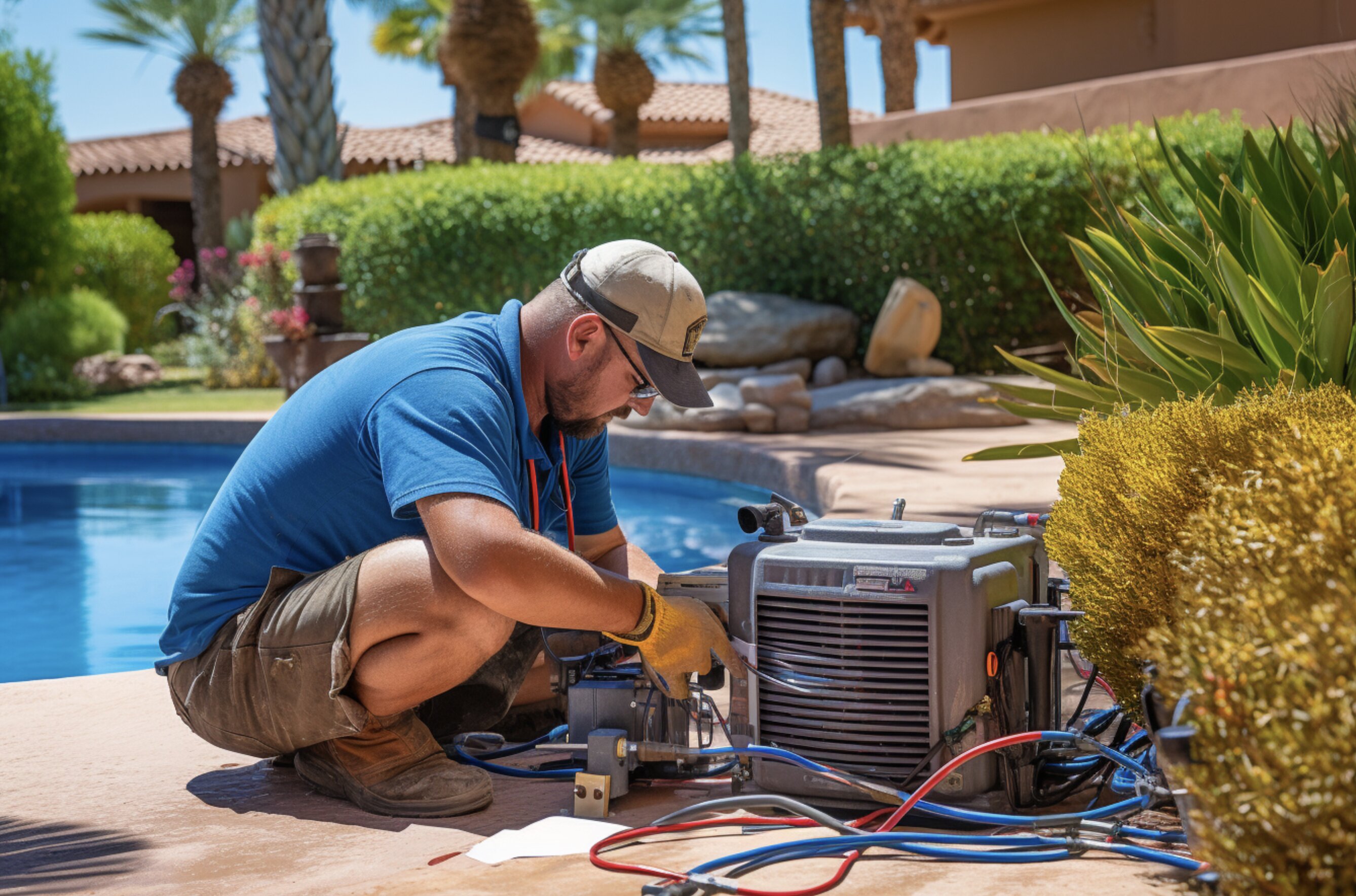
The first cool night of fall rolls in, you flip on the pool heater, and nothing happens. Or it clicks a few times and quits. Or it fires up, runs for two minutes, and shuts off. Now the water is 68 degrees and nobody wants to get in.
A heater that won’t light is one of the most common calls we get once October hits in Phoenix. Most of the time it’s not a dead heater. It’s something small that went wrong while the heater sat unused all summer. This guide walks through what to check, sorted by what your heater is doing. Some of it you can do yourself. Some of it you shouldn’t.
First, Know Which Kind of Heater You Have
There are two main types of pool heaters in the Valley, and they fail in different ways.
Gas heaters burn natural gas or propane. They heat water fast, which is why most spa owners have one. Inside there’s an igniter, a burner tray, a gas valve, and a set of safety switches. If any one of those switches says something is wrong, the heater won’t light.
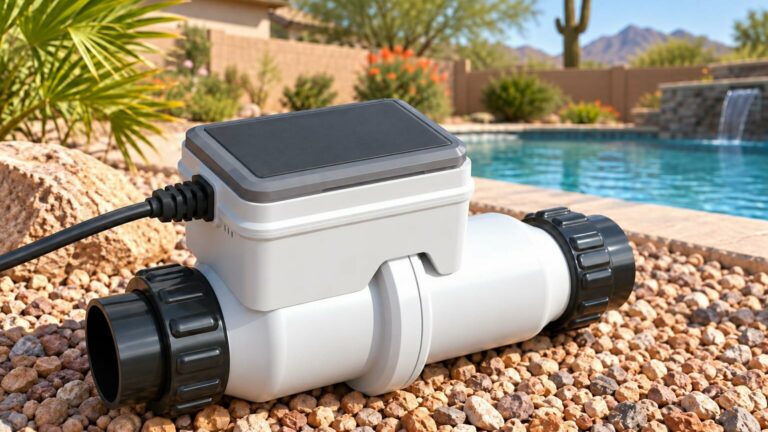
Heat pumps run on electricity. They pull heat out of the air and move it into the water, a lot like an air conditioner running backward. They heat slower but cost less to run in mild weather. A heat pump has a fan on top and a compressor inside.
Look at your equipment pad. If the heater has a gas line running to it and vents on top or on the side, it’s gas. If it has a big fan on top and looks like an AC unit, it’s a heat pump. The rest of this post covers both, with notes where they differ.
A safety note before you start: if you smell gas, turn the heater off, shut off the gas valve to the heater if you can reach it safely, and call your gas company. Don’t keep trying to light it. And never open the heater cabinet with the power on.
The Heater Does Nothing at All
No clicks, no fan, no lights on the control panel. Start here.
Check the power. Look at the breaker for the heater. Breakers can trip during a monsoon storm and stay off all summer without anyone noticing, since nobody needed heat. Flip it fully off and back on.
Check the control panel. Many heaters have an on/off button and a pool/spa setting. Make sure it’s on, and that the set temperature is higher than the water temperature. If the water is 75 and the heater is set to 72, it won’t fire.
Check your automation. If your pool runs on a control system, the heater may need to be turned on there too. Some systems have a “heater enable” setting that gets switched off for summer. Look for it in the app or on the panel.
Check the pump. A heater will not turn on unless water is flowing through it. That’s a safety rule built into every heater. If the pump is off, on a timer that hasn’t started yet, or running at a very low speed, the heater stays dark. Turn the pump on and give it a minute.
It Clicks but Won’t Light
You hear the heater try. There’s a click, maybe a fan, maybe a hiss. Then it stops, and you might see an error code.
Write down the error code. Every brand uses its own codes, and the code tells you a lot. Look it up in your manual, or take a photo and send it to whoever services your heater. Common ones point to low water pressure, an open safety switch, or a failed ignition.
Low water flow is the number one cause. The heater has a pressure switch that checks for enough flow. A dirty filter is the most common thing that trips it. If your filter pressure gauge reads high, the filter needs cleaning. Full skimmer and pump baskets do the same thing. Clean them out and try again. If you’re not sure how often your filter needs cleaning, our post on cartridge, DE, and sand filters covers that.
Valves can be set wrong. If someone turned a valve to send water to a waterfall or spa, the heater may not be getting enough flow. Make sure the valves are set for normal pool mode.
The gas may be off. On gas heaters, check that the gas valve to the heater is open. The handle should line up with the pipe. If you have other gas appliances, make sure they’re working. If none of them are, the problem is the gas supply, not the heater.
The igniter or flame sensor may be bad. If the flow and gas are fine and it still won’t light, the igniter may be cracked or the flame sensor may be dirty. These are inside the cabinet near the burners. This is where we suggest calling a repair tech, since you’re working near gas.
It Lights, Then Shuts Off
This one drives people crazy. The heater fires, you feel warm air from the vent, and then a few minutes later it shuts down.
Here’s what usually causes it:
- The filter is getting dirty. Flow drops after the heater starts, and the pressure switch shuts it off. Clean the filter.
- The heater is overheating inside. A high-limit switch shuts it off if it gets too hot. This happens when flow is low, or when scale has built up inside the heater so water can’t carry the heat away.
- The flame sensor can’t see the flame. A dirty or worn sensor tells the heater the flame went out, so it shuts the gas off for safety.
- Wind or a blocked vent. Strong gusts or a vent full of leaves can mess with the burn. Make sure the vents are clear.
- The set temperature is close to the water temperature. If it’s only a degree or two apart, the heater reaches it and stops. That’s normal.
If it keeps cycling on and off and none of the easy fixes help, it’s time for a tech to check the safety switches.
It Runs, but the Water Stays Cold
The heater is on and running, but the pool won’t warm up. This is more common with heat pumps.
Heat pumps struggle when it’s cold out. Most work best when the air is above 50 degrees. On a 45-degree Phoenix morning in January, a heat pump will run and run without doing much. It catches up in the afternoon. That’s not broken. It’s how they work.
The heater may be too small for the pool. A heater sized for a spa won’t heat a big pool fast. If you just moved in, the old owner may have only used it for the spa.
You’re losing heat as fast as you add it. A waterfall, a sheer descent, or a windy yard pulls heat out of the water fast. A solar cover helps a lot. So does running the water features less while you heat.
Scale is blocking heat transfer. We’ll get to this one next, because it’s a big deal in Phoenix.
Why Heaters Act Up More in Phoenix
Our heaters have a few problems you don’t see as much in other places.
They sit unused for months. Most Valley pool heaters are off from May to October. Things go wrong while they sit. Breakers trip in storms. Settings get changed. And critters move in.
Spiders, ants, and packrats. Black widows love the inside of a warm heater cabinet. Spider webs can block the small tube that feeds air to the burner, so it won’t light right. Ants nest in the control board. Packrats chew wires. When a heater won’t start in the fall, finding a nest inside is pretty common. Don’t stick your hand in there without gloves and a flashlight.
Hard water leaves scale. The heat exchanger is a set of copper tubes that the water runs through. Phoenix water is full of calcium, and heat makes calcium come out of the water faster. Over time, scale builds up inside those tubes. That slows the flow, makes the heater run hot, and trips the high-limit switch. It also makes the heater less efficient every year. Keeping your pH and calcium in range slows this down a lot. We keep calcium between 200 and 400 ppm and pH between 7.2 and 7.8. Our chemical balancing page explains why.
Water that’s out of balance eats the heater. Low pH water is the opposite problem. It slowly eats away at the copper inside the heater. If your water tests low on pH for months, the heat exchanger can start to leak. That’s an expensive fix.
A Quick Fall Startup Checklist
If you want to avoid the cold-water surprise, do this a week or two before you plan to use the heater:
- Clean the filter and empty the baskets.
- Check the breaker and make sure the control panel lights up.
- Look inside the vents for webs, nests, or leaves. Use a flashlight, and don’t reach in.
- Check that the gas valve is open, if you have a gas heater.
- Turn it on with the pump running and set the temperature a few degrees above the water.
- Stay nearby for 10 minutes and listen. A healthy heater lights within a minute and runs smoothly.
If it lights and runs, you’re set for the season. If it doesn’t, you’ve caught it before the first cold weekend.
When to Call a Pro
You can safely check power, settings, the pump, the filter, the valves, and the vents. Stop there if:
- You smell gas
- The heater shows an error code you can’t clear
- It lights and shuts off, and the filter is clean
- You see water leaking from the heater cabinet
- You see soot, scorch marks, or melted wires
- You find a rodent nest or chewed wires
Gas valves, igniters, flame sensors, and control boards are jobs for someone trained to work on them. A mistake with gas can hurt you.
Common Questions
How long does a pool heater last in Arizona?
Many gas heaters last around 8 to 12 years. Heat pumps can go longer with good care. Water balance is the biggest factor. A heater that ran on low pH water or got loaded with scale won’t last as long.
Is it worth fixing an old heater?
It depends on what failed. An igniter, a sensor, or a switch is usually worth replacing. A leaking heat exchanger on an older heater often isn’t. A tech can tell you which one you’re dealing with.
Should I cover my heater in the summer?
Not with anything airtight, since it can trap moisture. Keeping the vents clear and the area around it free of weeds and junk does more good. A quick look inside before fall is the best habit.
Can I run my heater all winter?
You can. In Phoenix, most people heat the spa more than the pool, since spa water heats in minutes. Heating a whole pool in December takes a lot of gas or power. A solar cover cuts that cost a lot.
Still Cold?
If you’ve worked through this list and your heater still won’t light, our repair techs can find the problem. We work on Pentair, Hayward, and Jandy heaters, both gas and heat pumps. See our pool heater repair page, call (623) 526-4945, or request a repair visit online.